
How Quality Control Shapes the Consistency of Screen Printing Mesh
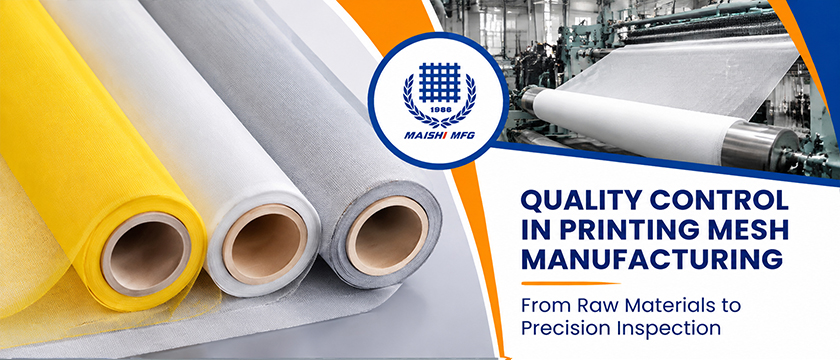
A high-quality screen printing mesh starts with carefully selected raw materials and continues through controlled weaving, finishing and inspection. Each stage contributes to the final fabric structure and performance.
MAISHI provides polyester, nylon and stainless steel printing mesh for textile, packaging, glass, ceramic, electronics and other industrial printing applications.
Raw Material Inspection: The Foundation of Mesh Quality
The quality of printing mesh begins with the yarn or wire used during manufacturing. Differences in diameter, tensile properties and surface condition may affect the uniformity of the finished fabric.For polyester and nylon printing mesh, monofilament yarn quality is important for maintaining consistent thread dimensions and mechanical properties. For stainless steel mesh, incoming wire is inspected for tensile properties, roundness, surface condition and dimensional tolerances.
MAISHI offers stainless steel printing mesh in AISI 304, 304L, 316 and 316L materials, providing options for different industrial printing requirements.
Precision Weaving and Manufacturing Control
The weaving process determines the arrangement of warp and weft threads, directly influencing mesh count, opening size and fabric uniformity.MAISHI manufactures polyester and nylon mesh using monofilament yarns, while stainless steel printing mesh is available in plain weave and twill weave structures.
Different materials offer different advantages:
Polyester Printing Mesh: Good dimensional stability and tension retention for textile, packaging, glass and ceramic printing.
Nylon Printing Mesh: Flexibility, elasticity and abrasion resistance for applications involving curved surfaces or repeated contact.
Stainless Steel Printing Mesh: High strength, precise openings and low elongation for demanding applications such as PCB and electronics printing.
Consistent weaving conditions help maintain uniform mesh openings and reliable product specifications.
Heat Setting and Quality Inspection
After weaving, finishing and inspection processes help establish the final physical properties of printing mesh.According to MAISHI's manufacturing catalogue, polyester mesh undergoes heat-setting treatment, followed by physical property inspection and tension adjustment.
Finished mesh is evaluated through several important parameters:
Mesh Count: Determines the number of threads per unit of length.
Thread Diameter: Influences opening dimensions and open area.
Mesh Opening: Determines the available space between threads.
Thickness: Describes the physical structure of the fabric.
Elongation and Tensile Strength: Help evaluate mechanical performance under tension.
For stainless steel mesh, additional inspections cover broken wires, missing warp or weft threads and sliding wires. The catalogue also references ISO 9044 for inspection procedures.
These checks help identify manufacturing defects and maintain consistent product quality.
Matching Mesh Quality to Printing Applications
Different printing processes have different mesh requirements.In textile printing, uniform openings and stable tension help maintain repeatable printing conditions. In glass and ceramic printing, consistent mesh structures support controlled ink deposition and decorative pattern reproduction.
For PCB and electronic printing, precise openings and dimensional stability are particularly important for reproducing fine patterns.
For example, a textile manufacturer producing detailed fabric patterns may require polyester mesh with consistent mesh count and tension characteristics. A PCB manufacturer may consider stainless steel mesh where precise openings and low elongation are important.
The appropriate specification should always be evaluated according to the printing design, ink properties, substrate and production conditions.
MAISHI: Consistent Manufacturing for Reliable Printing Mesh
Since 1986, MAISHI has focused on wire mesh manufacturing, providing precision woven mesh products for customers worldwide.Our printing mesh range includes polyester, nylon and stainless steel options with different mesh counts, thread diameters and opening specifications.
From raw material inspection and precision weaving to heat setting and finished product testing, we focus on manufacturing consistency at every important stage.
Whether you need mesh for textile decoration, glass printing, ceramic applications or precision electronics printing, MAISHI provides different material options and customized specifications to support your production requirements.
Looking for a reliable screen printing mesh supplier?
Contact MAISHI to discuss your material requirements and printing applications.
Hear our news first
Want to hear our news as it happens, and be the first to see our most exciting stories? Subscribing to our news releases and newsletters including Snapshot will give you the latest info.
-
How Quality Control Shapes the Consistency of Screen Printing Mesh...
-
How Quality Control Shapes the Consistency of Screen Printing Mesh...
-
Improving Particle Separation with the Right Industrial Filter Mesh...
-
How Filter Mesh Design Impacts Industrial Filtration Performance...
-
Why Is the Right Filter Mesh Important for Reliable Industrial Filtration?...
-
How Does MAISHI Filter Mesh Improve Reliability in Industrial Liquid Filtration?...
-
Why Is Stainless Steel Wire Mesh Suitable for Coconut Milk & Water Filtration...
-
Why Nylon Filter Mesh is Essential for Precision in Luminescence Dating Labs...